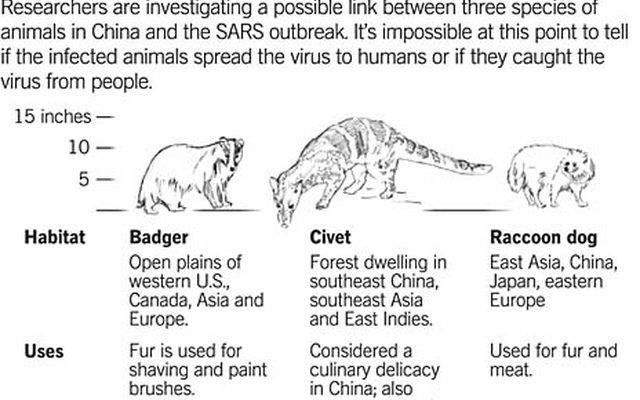
File this under who knew. The raccoon dog is real and he's got the SARS. What I want to know is who thought to eat this incredibly ugly animal. My research also uncovered a few Chinese fairy tales featuring this creature.
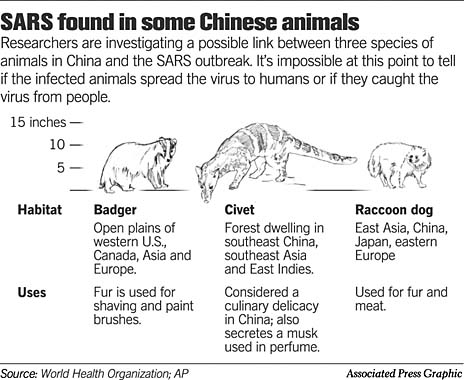
Description: Long brindled black-brown body fur with black facial mask, sleek black legs, and black fur on upper side of tail. Long guard hairs up to 120 mm long, winter coat developed by Nov.-Dec.; under-fur moults by Feb.-Mar. and winter coat moulted by June. Head-and-body length: 50-60 cm. Tail length: 18 cm. Shoulder height: 20 cm. Weight: 7.5 kg.
Reproduction: Time of mating: Jan.-Mar. Gestation: 60-65 days. Litter size: 4-6, but can reach 12 (Ikeda 1983). Lactation: 30 days. Age at sexual maturity: 9-11 months (Ikeda pers. comm.). Longevity: 11 years in captivity, 3-4 years in the wild (Ikeda, pers. comm.).
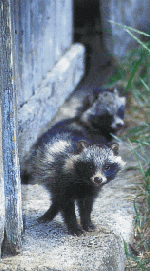

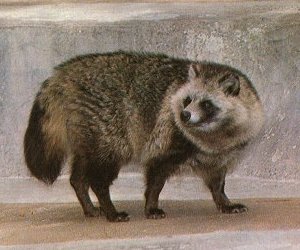

Raccoon dogs use latrine sites, and a study in Japan showed that each animal was using at least ten different latrines (Ikeda 1984, 1987a). These were distributed unevenly within the home range. Ikeda suggests these may play a role as landmarks and points of information transfer. Hibernates in semi-torpor.
Distribution: East Asia, Far East, east Siberia, Manchuria, China and Japan, and northern Indo-Chinese Peninsula. The actual distribution and extent of range on the Asian mainland today is not well known. Introduced into Europe: 1927-1957: about 9,000 individuals introduced into the western Soviet Union for fur-farming; spread slowly to Poland, also known in East Germany, Czechoslovakia, and Romania. Occasionally caught in West Germany even near Danish and French borders.
Habitat: Woodland and forested river valleys.
China: Once thought to occur widely; today it is not well known and may be in danger of local extinction.
Japan: Abundant throughout
(Ikeda 1987b).
Europe: Thought to be spreading rapidly now in eastern Europe. May occur in Sweden; in Finland it is fairly common in the east, south, and central, more scattered in the southwest and in west Finland; some individuals have even been detected in northern Norway.
Commercial Use: About
70,000 individuals are hunted annually in Japan. The majority of pelts are
produced in Finland (mainly from farmed animals) and the Soviet Union
(mainly from wild animals). There has been some production in Denmark and
central European countries. Historically, hunting began in Russia in 1928.
Breeding animals were exported to Germany in the 1930s, but the population
was wiped out by disease in 1973.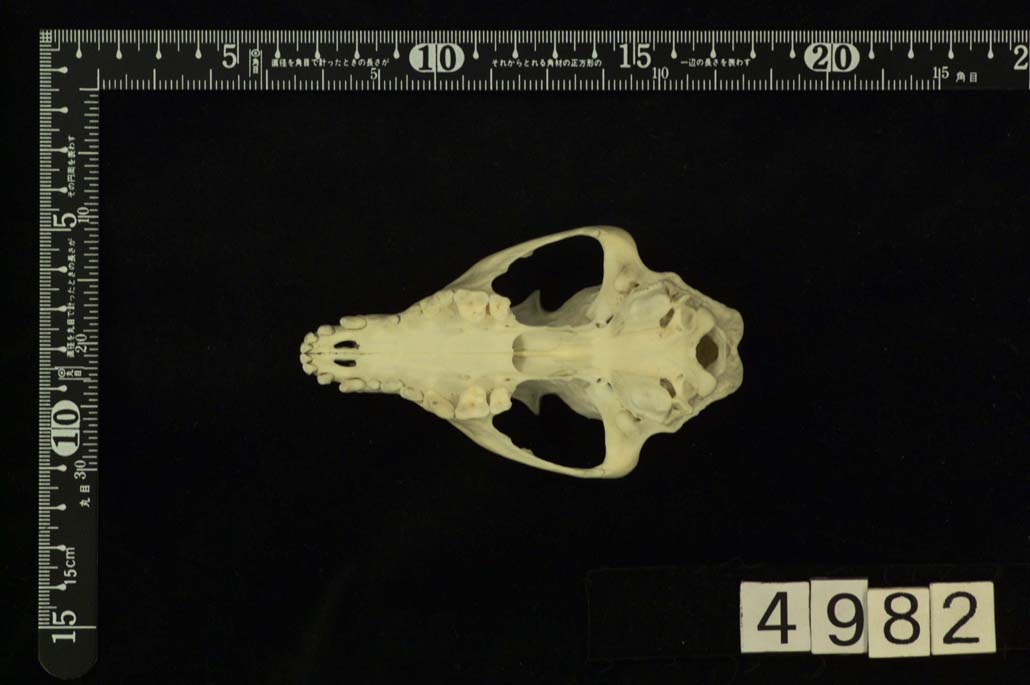
Threats: Rabies and rapid urbanization appear to be causing local extinction in parts of Japan. Surprisingly, despite its widespread distribution, there is a lack of interest in the raccoon dogs among Japanese people. Hence, an education campaign in Japan would be a valuable addition to conservation plans.
Current Research Programs: None known.
Conservation Measures Taken: In Japan, a small island (7.9 km2) has been protected for raccoon dog habitat by being designated as a Natural Monument under the Law For Protection of Cultural Properties (Ikeda pers. comm.)